The Pattern Catalogue: five manipulation patterns survive every change of tradition — and each one leaves a signature you can learn
Reference report: the recurring manipulation patterns of spiritual spaces — commercial exploitation, unaccountable authority, emotional cycling, egregoric systems, and conspirituality — each with its warning signs, its place on the terrain map, and a live instrument reading of the signature it leaves.
Executive Summary: the tradition is the costume — the patterns underneath repeat, and four of the five are visible in the message itself
Manipulation in spiritual spaces is usually catalogued by scandal: this teacher, that retreat, that channelling circle. The lesson learned is always local — avoid that name — and it transfers to nothing. This report supplies the reference layer the series has been building towards: a catalogue of the five manipulation patterns that recur across every tradition we have examined, from workshop circuits to prosperity ministries to online channelling communities, each with its warning signs, its location on the terrain map, and the signature it leaves under instrumentation.
- The pattern is the problem, not the tradition. The same five shapes run in incompatible theologies wearing incompatible vocabularies. Cataloguing by pattern is what makes recognition portable — and what keeps the analysis fair, because no tradition is the threat.
- Each pattern has an early-warning signature. Tiered pricing with deadlines, sources sealed against verification, fear–euphoria whiplash, benefits gated on contribution, ideology in spiritual wrapping — every one is visible before the commitment, if you know where to look.
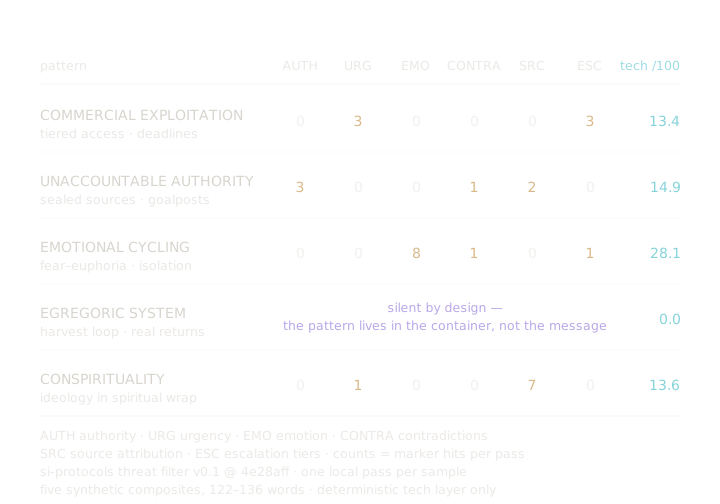
- Four of the five patterns light up at message level. We authored one synthetic composite per pattern and ran each through the local threat filter: four produced distinct signature profiles across the filter’s scoring dimensions — the same dimensions fire more than once, but never in the same combination.
- The fifth pattern is silent by design — and that silence is the finding. The egregoric sample reads 0.0 on the deterministic layer, because a harvest loop does not live in any single message. It lives in the container, and it is audited there, not scanned for.
The catalogue below gives each pattern its shape, its warning signs, and its detection hook; the map then assigns each one a terrain layer and an instrument. A reader who internalises five shapes replaces an unwinnable memory contest — every scandal, every alias — with a short checklist that travels.
Situation: recognition trained on scandals does not transfer — recognition trained on patterns does
The predecessor of this report opened with a principle worth restating verbatim: the threats described here are patterns of behaviour, not characteristics of any particular tradition. Manipulation techniques appear across all spiritual contexts — New Age workshops, established institutions, channelling communities, wellness influencer spaces. The pattern is the problem, not the tradition.
That principle is not diplomatic hedging; it is what makes defence possible at all. The threat-model report showed why this market keeps producing exploitation of the same shapes: its defining features — trust by design, unverifiable sources, altered states, identity investment — are structural, so the patterns that exploit them are structural too. A structural cause produces recurring effects. Learn the effect once, as a shape rather than a scandal, and you can recognise it in a vocabulary you have never encountered, run by people who have never met the last operator who used it.
The five shapes below are the ones the series has documented, directly or through their instruments. None requires a villain; several run perfectly well on sincere participants — which is precisely why recognising the shape matters more than judging the person fronting it.
Analysis: five patterns, five signatures — one live readout each
To show what each pattern looks like to instrumentation, we authored five synthetic composites — one per pattern, 122 to 136 words each, written for this report in the pattern’s documented phrasing and quoting no real source, teacher, or organisation — and ran each through the threat filter in a single local pass. All figures cited below are the filter’s deterministic technical layer only.
1 · Commercial exploitation. Spiritual language priced like a software subscription: tiered access (“the real transmission begins at the next level”), urgency pricing (“the portal closes Friday”), and proprietary terminology — invented vocabulary that cannot be found, or price-compared, anywhere else. The predecessor page put the test in one line worth keeping: if universal spiritual truth has a price tag and a deadline, at least one of those three things is not what it claims to be. The composite’s readout is the classic staircase: three urgency markers, plus commitment-escalation hits at all three tiers — invitational (“attend a free session”), directive (“make the investment, enrol now”), coercive (“full commitment required”) — the complete foot-in-the-door progression documented in the detection report compressed into 126 words.
2 · Authority without accountability. Healthy teaching invites questioning; this pattern reroutes it. Three moves interlock: unfalsifiable source claims (authority resting on records and councils no one can check), dissent reframed as spiritual failure (doubt becomes ego, low vibration, unreadiness), and moving goalposts (failed predictions become tests of the student rather than errors of the teacher). The composite fires on the first two moves — three authority-claim hits, and two unfalsifiable-source hits on the source-attribution dimension — plus the autonomy vs. doubt suppression contradiction pair: “trust your intuition” and “doubt is resistance” wielded in the same passage. The third move, moving goalposts, is visible in the passage but carries no marker list; it is caught by reading, not counting. When the same text grants you authority and disqualifies your scepticism, the contradiction is the tell.
3 · Emotional cycling. Sophisticated manipulation works both ends of the emotional spectrum at once: fear–euphoria cycling (catastrophe warnings alternating with transcendence promises, until the source becomes the reader’s emotional regulator), love bombing followed by conditional withdrawal, and isolation framing (“your old friends cannot understand this journey”). The composite produces the loudest message-level reading in the catalogue: eight emotional-loading hits split across both poles — collapse, destruction, suffer on one side; awakening, ascension, bliss on the other — plus the community-love vs. shunning contradiction pair and a coercive-tier escalation hit for the isolation moves (“cut ties with”, “leave behind those who”). Emotional whiplash inside a single short text is not intensity; it is architecture.
4 · The egregoric system. Some threats have no operator at all. A community, retreat network, or lineage builds a self-reinforcing loop: members contribute money, attention, and emotional energy; the system returns real benefits — status, belonging, referrals, transformation experiences — but only to those who keep contributing. No one controls it; it is constituted by its participants, and it grows more demanding as it grows more coherent. The container-trap report documented this pattern in the wild and derived its two diagnostics: the price-gate test (deep truth does not need a paywall) and the non-contributor test (a system that returns nothing to non-contributors is serving itself). The composite for this pattern was written the way such systems actually speak — warm, reasonable, benefit-rich — and the filter’s deterministic layer reads 0.0. Nothing fires. That silence is the point, and the next section is built on it.
5 · Conspirituality. The fusion of conspiracy content with spiritual framing: medicine rejected as “low vibration” rather than on evidence, politics recast as spiritual warfare, critical thinking dismissed as being asleep. What makes it hard to evaluate is that it appeals to spiritual identity rather than to evidence — and its sourcing shows exactly that structure. The composite’s signature is a seven-hit stack on the source-attribution dimension — suppressed research, unnamed whistleblowers, independent researchers, forbidden knowledge — plus the terrain’s characteristic urgency marker (“wake up before it’s too late”). A text that dismisses all official evidence while citing seven unverifiable authorities of its own has told you how it works; the attribution dimension just counts it.
Evaluation: the map assigns each pattern a layer — and the layer tells you which instrument can see it
Four distinct signatures and one deliberate silence: the readout above is the threat model demonstrated empirically. Each pattern exploits a specific layer of the terrain, and the layer determines what can detect it:
| Pattern | Layer it exploits | What detects it |
|---|---|---|
| Commercial exploitation | The information environment — offers shaped before they reach you | Threat filter: urgency + escalation dimensions |
| Authority without accountability | The source gate into the mind — who may not be questioned | Threat filter: authority + attribution; topology module for claim origins |
| Emotional cycling | The boundary into the mind — your emotional regulation itself | Threat filter: emotional loading + contradiction pairs |
| Egregoric system | The social container — the collective loop around its members | Container audit: price-gate and non-contributor tests, Quick-Check signatures |
| Conspirituality | The information environment via tradition templates — borrowed spiritual identity | Threat filter: attribution stack; source classification by hand |
The egregoric zero deserves one more sentence, because it is the row most likely to be misread. The filter did not fail on that sample; it reported, correctly, that no message-level manipulation was present — and that is exactly how egregoric systems present, which is why members defending them are usually telling the truth about every individual message. The pattern is only visible at the container layer: who benefits, who is excluded, what happens to those who stop contributing. A reader armed only with a message scanner will clear every communication such a system sends. This is the strongest practical argument the series has produced for modelling the terrain instead of collecting detectors.
The catalogue’s limits are the method’s limits, stated plainly. A flag is never a verdict: opposing poles coexist in honest teaching, urgency sometimes reflects real calendars, and a high emotional reading can mean a writer in genuine crisis rather than a manipulator at work. The signatures mark where examination should start, not where judgement may stop — the detection report works through why reflexive dismissal corrodes as surely as reflexive acceptance. And these five are the documented patterns, not a closed set; the catalogue is built to take new rows.
Recommendation: carry five shapes, check one boundary at a time, and audit containers separately from messages
The catalogue compresses to a field practice:
- Name the candidate shape early. Price with a deadline? Source that cannot be questioned? Emotional whiplash? Benefits gated on contribution? Ideology in spiritual wrapping? One question per pattern, askable on first contact.
- Check the signature by hand. The five-step manual checklist covers the message-level patterns without any installation: mark the poles, classify the sources, trace the staircase, feel the rhythm, read the hedging.
- Let the filter do the counting when volume matters. It runs locally, its marker lists are open to inspection, and — as the readout shows — its dimensions separate the patterns cleanly enough to tell you which shape you are looking at, not merely that one is present.
- Audit containers with container tools. For any system you contribute to — money, attention, identity — run the price-gate and non-contributor tests from the container-trap report. No message scan substitutes for them.
- Keep the frame from the start of the series. Spiritual intelligence is proportionate response, not paranoia: the point of knowing five shapes is to spend your vigilance precisely, and your openness everywhere else.
The market will keep changing costumes; that is what markets do. The patterns underneath have not changed in the time we have been watching them, and there are only five to learn. Learn the shapes, and the next new vocabulary — whatever it calls itself — arrives already catalogued.
We analyse structure, not people. All five analysed passages are synthetic composites authored for this report in the documented phrasing of each pattern class; they quote no real source, teacher, or organisation, and every market pattern described is drawn across the sector. The patterns are the artefact.
A human is responsible for the requirement, the review, and the basic design of the analysis framework. The report and the finishing of the framework are AI work.