What Spiritual Intelligence Is — and What It Is Not
A positioning briefing for the curious-but-critical: why the spiritual market now needs its own discernment discipline, what spiritual intelligence actually analyses, and the five objections that keep people from using it.
Key Judgements: discernment and openness are not opponents — and the delivery layer of spiritual content is measurable
- Spiritual intelligence is media literacy for metaphysical spaces. It is the capacity to engage with spiritual content whilst maintaining healthy discernment — it evaluates how content is delivered, and never whether a belief is true.
- The old safeguards no longer bind. Content that once travelled through personal relationships now arrives through algorithms, to people in vulnerable states, carrying claims that fact-checking cannot follow into unverifiable territory. Pattern analysis can.
- The delivery layer is measurable. Artificial urgency, unverifiable authority, emotional loading, sealed sources — observable, consistent across traditions, and detectable in one local instrument pass: a synthetic sample built from documented tropes flags sixteen markers across four categories (real run below).
- The loudest objections to discernment are themselves delivery patterns. “Critical thinking kills spirituality” and “if it resonates, it must be true” serve whoever benefits from unquestioned acceptance; the contemplative traditions themselves embed testing and verification.
- The posture to adopt is informed openness. Discernment is not scepticism — it is a form of self-care, and it works with curiosity, not against it.
Situation: the distribution of spiritual content changed faster than its safeguards
Spiritual and metaphysical content once moved through personal relationships and local communities — channels with built-in context and accountability. It now arrives through algorithmic feeds and anonymous channels, and it finds people at their most open: processing grief, navigating transitions, searching for meaning. That combination — industrial distribution, vulnerable receivers — is what makes the terrain exploitable for financial gain, social control, and ideological manipulation. The wave of deep dives preceding this briefing mapped those mechanisms in detail; this briefing is about the capacity that defends against them.
The obvious safeguard does not transfer. Conventional fact-checking works on empirical claims — dates, statistics, scientific consensus. Claims about energy, consciousness, past lives, or channelled sources sit outside its reach: no fact-checker can confirm or deny what an unverifiable realm did or did not say. That does not make such claims false. It means the usual protection simply does not apply — and whatever protection replaces it must work on something other than truth.
Analysis: the delivery layer separates cleanly from the belief layer — and one instrument pass makes it visible
What can be analysed is the pattern of communication wrapped around a claim. Does the message create artificial urgency? Does it discourage independent verification? Does it establish authority through sources that cannot be checked? Does it use emotional loading to bypass reflection? These properties live in the delivery, not the belief — a genuine teaching and a manipulative one can make identical metaphysical claims and still differ completely here. That separation is the working core of spiritual intelligence: the belief layer is yours; the delivery layer is measurable.
Measurable is meant literally. We ran the open-source instruments over a synthetic composite — a 122-word passage authored for this briefing from documented rhetoric tropes, quoting no real source:
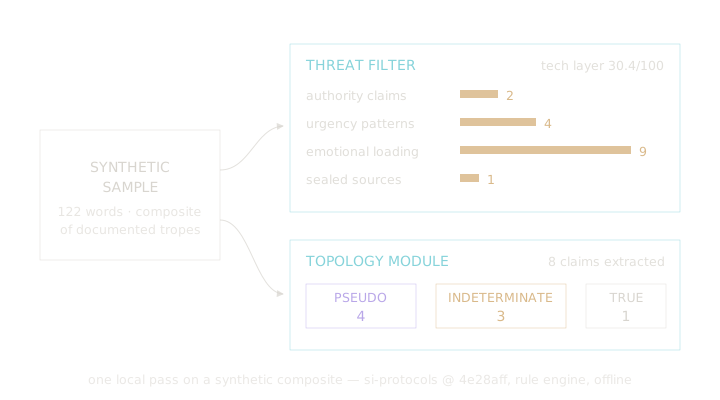
Two things in that result carry the argument. First, the flags are specific: not “this feels off”, but two unverifiable authority claims, four urgency patterns, nine emotional-loading markers, one sealed source. The shift from unease to named patterns is the entire value proposition. Second, the classification is not binary: of eight extracted claims, one the engine classes as true, three as indeterminate, four as pseudo-claims — a mixed text, which is what real texts are. An instrument that returned a verdict instead of a map would itself be an authority you could not question.
And every part of that pass is inspectable: every marker list, every scoring weight, every classification rule is open source, and the run happens on your machine, offline. Nothing you analyse leaves your hands.
Evaluation: each common objection, weighed — what it claims versus what it serves
The objections to this practice are predictable, persistent — and worth taking seriously, because each one contains a real value bent out of shape:
| Objection | The real value inside it | What the objection actually serves |
|---|---|---|
| “Critical thinking kills spirituality” | Analysis alone is not a spiritual life | Unquestioned acceptance. The traditions themselves disagree: Buddhist right view, Sufi tafakkur, initiatory testing all embed discernment. Critical thinking kills exploitation, not spirituality. |
| “High-vibration people do not question” | Aspiration to growth | A hierarchy in which questioning marks you as lesser — dissent silenced by rank. Genuine development increases nuance; it does not retire it. |
| “It is all about energy — just feel it” | Subjective experience is real data | Engineered feelings: environmental design, breathwork arousal, social pressure, and authority anchoring all produce genuine sensations on demand. Feelings are data, not conclusions. |
| “This tool debunks my beliefs” | Beliefs deserve respect | A misread — the instruments never evaluate metaphysical truth. Identical claims can score differently on delivery alone; the flags mark technique, not doctrine. |
| “If it resonates, it must be true” | Resonance often marks insight | Content designed to resonate: cold reading, Barnum statements, confirmation bias. The question is not whether it resonates but why. |
Read the third column as a set: every objection, followed to its end, asks you to hand over the one faculty that would let you audit the arrangement. That convergence is not a coincidence — it is the signature of the delivery patterns this practice exists to catch.
Recommendation: adopt informed openness — four questions, one local instrument, and the map when you need it
Start with the four questions as a habit, applied to any spiritual content that asks something of you — attention, money, commitment, belief: does it manufacture urgency; does it discourage verification; does it borrow authority from sources that cannot be checked; does it route around reflection through emotion? Pattern presence is a flag for inspection, not a verdict — genuine teaching trips these wires too, occasionally. It is the stack of them that tells.
When a text matters enough to check properly, run the instruments — they are local, open, auditable, and free, which is a security property, not a distribution choice. And when you want the structure behind the patterns — why sincere creators relay payloads, why the returns on a costly retreat are real, where these mechanisms live in the terrain — the three deep dives that opened this series carry the map: The Compromised Host, The Guru Retreat as a Container Trap, and Why the Spiritual Industry Needs a Threat Model.
None of this asks you to approach the spiritual life with hostility. The best of it has always come from openness and discernment working together — informed openness is simply that, named. The same openness that allows genuine insight also creates exposure; tending the second is how you keep the first.
We analyse structure, not people. The instrument run shown is a single local pass over a synthetic composite authored for this briefing from documented rhetoric tropes — it quotes no real source, teacher, or organisation. The patterns are the artefact.
A human is responsible for the requirement, the review, and the basic design of the analysis framework. The report and the finishing of the framework are AI work.