COGINT Ontology: how Sephirot and leverage points work together against disinformation
By joining the Kabbalistic Four Worlds with the Sephirot and with leverage points from system dynamics, you can test whether different attacks share a strategy. A machine-readable ontology names the leverage points a defender can press.
A short public message can move more than one lever at once. Most defence still answers the last slogan. This briefing uses a machine-readable ontology — Four Worlds, Sephirot as leverage nodes, Meadows ranks — to read three entertainment-surface patterns and say where a defender should spend effort.
A path here is a route on the Tree of Life that an attack is allowed to take. A walk is the route it actually takes.
Key Judgements: the ontology shows which leverage an attack reuses
- Three public forms — a pile-on, a channelled tarot reading, a “light has won” message — reuse the same mid-tree path through information structure and flow (Tiferet) and through amplification (Netzach and Hod).
- They differ above that hub. Correction skips rules and runs on volume. The reading grows dependence through self-organisation: both sides take the sitting into their own world. The light-authority message writes a rule that turns checking itself into a fault.
- That difference is usable. If two operations share the flow hub, one defensive template on how information is wired covers more than one slogan.
- The ontology can name a control node. It cannot yet record that the node is firing the wrong way, or that a session setting moved after the clip ended. Those are limits. They are not a reason to ignore the hub.
The machine-readable model: four-worlds-threat-model-v1.1.yaml
Published as a file rather than a description of one: four worlds, ten leverage nodes, twenty-two legal paths, two transports, and the invariants a claim has to satisfy or it fails the check. If an invariant is wrong, the file is the thing to show wrong.
The model: four-worlds-threat-model-v1.1.yaml.
Situation: entertainment messages are hitting several levers at once
Cognitive warfare is a formalised military idea, not a metaphor. A NATO-sponsored study treats the brain as a battlefield of this century and argues for a human domain to cover operations against it (du Cluzel, 2020). Read the interest in view: a sponsored paper has reason to make the threat look large. What it establishes is that the concept is on the books.
The live problem on the open surface is smaller and nearer. Entertainment content — a clip, a reading, a feed — lands on language, custom, doctrine, and ethics. An earlier briefing on this site set those four out as the public impact point (The Four Worlds as a Cognitive Warfare Grid).
Attackers do not need the rest of your system to reach them. What they spend on is leverage: a change high in the stack is cheap to launch and expensive to unwind. Most people still toggle the lowest settings — wording, volume, a blocked account.
Three forms keep turning up. Detail waits for the next section.
Correction economy. A clip is framed, then “corrected” in public. Volume and exposure are the score. Rules of evidence stay dark. Heat lasts after the clip is gone.
Oracular dependence. A tarot reading delivered with channelling. Not a shop product. The sitting itself is disposable. What it leaves is a habit of return, and sometimes a small group that now shares one store of meaning.
Light-authority filter. One message, spoken with the unverifiable authority of a force of light: the war is already won; attending to fear feeds darkness; the waking notice fake news. No purchase. No ritual. A new session rule: drop anything that raises doubt.
Light versus dark is an old stock phrase. The authority is the point. Nothing in the message can be checked except by the rule the message itself installs.
Analysis: three attacks share a flow hub and amplify through emotion
The ontology joins two maps. The Kabbalistic Four Worlds are stages of how an idea becomes an act. The Sephirot sit on those stages as leverage nodes. The ranks follow Meadows: paradigm at the top, parameters at the bottom (Meadows, 1999). The lowest node carrying structure, buffers and parameters is a 2026 reading laid over the traditional frame.
| Rank | Leverage | Sephirah | World |
|---|---|---|---|
| 1 | Transcending paradigms | Keter | Atziluth (virtual universe) |
| 2 | Mindset | Chokhmah | Briah (genetic repository) |
| 3 | Goals | Binah | Briah (genetic repository) |
| 4 | Self-organisation | Chesed | Yetzirah (fluid) |
| 5 | Rules | Gevurah | Yetzirah (fluid) |
| 6 | Information structure and flow | Tiferet | Yetzirah (fluid) |
| 7 | Reinforcing feedback | Netzach | Yetzirah (fluid) |
| 8 | Restraining feedback | Hod | Yetzirah (fluid) |
| 9 | Delays | Yesod | Yetzirah (fluid) |
| 10 | Physical structure | Malkuth | Assiah (ego system) |
| 11 | Buffers | Malkuth | Assiah (ego system) |
| 12 | Parameters | Malkuth | Assiah (ego system) |
What the three patterns share is not the slogan. It is the mid-tree.
All three paths pass Tiferet — information structure and flow. The working part of the content is how it is wired, not the last sentence.
All three then push the formative world: thought and emotion. A single item is meant to grow there, out of proportion to its length.
The three paths need not fire in one order. They can start from Tiferet at different times. That is why one clip can look small and still move several levers.
The ego system reads the item and starts more than one path. What accumulates — an inherited pattern, an “awakened” identity, a need to return — is not on the item. It is stored deeper.
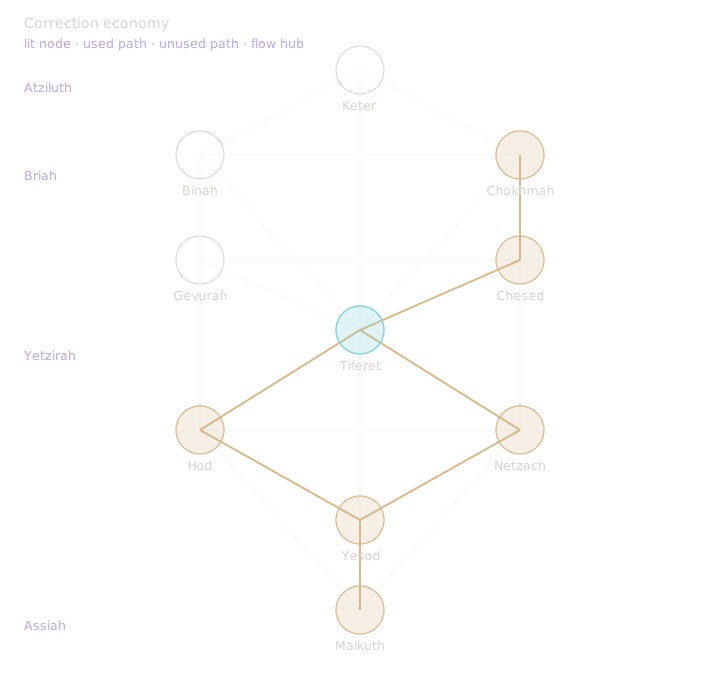
Correction economy. Mindset joins self-organisation and goes straight to flow. Rules stay quiet. The fight does not run on new standards of evidence. It runs on volume. Below the hub the same pair of paths appears in all three cases: flow to boost and to check, then delay, then behaviour.
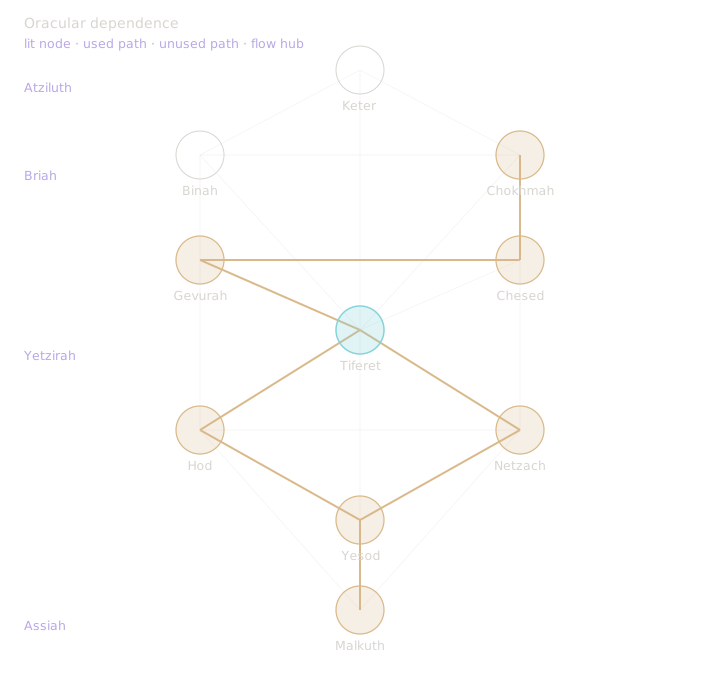
Oracular dependence. The distinctive work is self-organisation. Reader and reader-of-readers both fold the sitting into their own world. A small group can form around that shared store. Mindset lights; rules light as well — the sitting does set a standard — but that is not what separates it from correction. Transcending paradigms and goals stay dark. The sitting does not rewrite a purpose. It is taken in, and it grows.
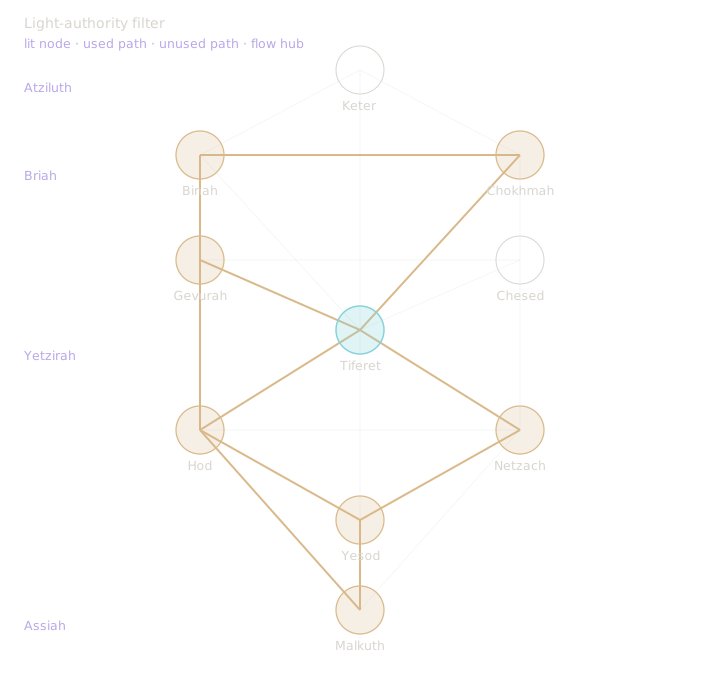
Light-authority filter. This one does not build a community first. Self-organisation stays dark. Mindset sets a binary. Goals become “do not feed darkness”. Rules become “looking at fear is complicity”. That rule is aimed at the checking node.
Social proof — people are waking — boosts. Proof of victory is declared and postponed. There is also a direct drop from the checker to behaviour: the new setting lands as a parameter without waiting for the rest of the lower path.
The light-authority case uses paths the other two do not, including the edge from rules to the checker. That is how the ontology tells the three apart. It is also the signature of the operation: checking the claim becomes evidence that you are feeding darkness.
None of the three is a claim that the archetypal world was rewritten. The messages use light and dark. That is not the same as changing the archetypes.
Evaluation: information structure and flow is the strongest shared lever
The hypothesis was this: different surfaces can hide the same strategy, and the strategy worth defending first is the one they share.
The three patterns support it. Three slogans. One flow hub. One amplification pair. The light-authority case is separable because it uses a path the others do not — rules aimed at the checker. A defender who only answers “light has won” will miss the filter. A defender who watches how information is allowed to move will see all three.
Counter-evidence, stated plainly.
Which nodes light in the light-authority case is a reading of one message. Other messages in the same genre may light the group-forming node instead. The path should be re-drawn on the next few items, not treated as a type for the whole genre.
The ontology can say a checking node is in play. It cannot say that node is now firing at the checker. That state still lives in prose.
A change to “what I will look at tomorrow” is visible in behaviour. It is not yet a field the ontology can fail a claim against.
A path that looks aimed can also be ordinary cultural drift. The ontology locates a change. It does not prove intent.
Clocks are still unmeasured. An earlier briefing already said the model has direction and not time of flight. This piece does not repeat that as news.
Verdict: treat information structure and flow as the first defensive target. Keep the two missing states as known gaps. Do not wait for the next revision before watching the hub.
Bias check: the three cases were chosen because they parse. A campaign that will not parse is not in the set. That is honest selection, and it caps how far “all attacks share this hub” may be pushed.
The file’s own metadata still classifies the model as a decision — a doctrine artefact, superseded by revision rather than falsified by evidence. Argue with it. Do not mistake it for a measurement.
Recommendation: put yesterday’s messages through the ontology and watch the flow hub
You do not need to read the file as code. You do need to stop swallowing yesterday’s messages whole. Six steps.
1. List the landing. What words, customs, doctrines, or duties did the message touch? If you cannot point to one of those four, you do not yet have an impact. You have a mood.
A feed item uses “awake” as a side, not a state. That is language and a social convention. It is already an impact point.
2. Draw the path. Which leverage nodes did it need — mindset, goals, rules, flow, boost, check, delay, behaviour? Drop any jump the Tree does not allow. If you cannot name the nodes, you are still arguing with the slogan.
3. Mark the hub. If the path goes through information structure and flow, treat that as the main target. The slogan is downstream. Two of the three patterns above can be answered with one template on wiring, not with two essays.
4. Watch amplification. Did emotion grow after the clip ended? Did a checking habit turn into a ban on checking? Those are the two control nodes. Boost without a check is how volume becomes a score. A check aimed at the checker is how a rule becomes a filter.
5. Watch what remains. After the message is gone, did taste, loyalty, or “I will not look at that” stay behind? That remainder is the deep write: mindset as a lasting programme, and a change to the ego system’s settings. Log the date, the remainder, and which carrier you think produced it. The ontology cannot yet store that line. A dated note can.
6. Reuse the template. If a new slogan lights the same flow hub, use the same counter on wiring and amplification. Do not write a new rebuttal for every phrase.
Spend less effort arguing volume and score. Those are the lowest ranks. Spend more on how information is structured and how it is allowed to move. That is where these three operations agreed.
When you write a defence, state the path and the test. Do not write “fear this theme”. The light-authority rule is already waiting to class that sentence as darkness.
Hand the file to an AI assistant or AI agent you already use, with the message under test, and ask it to name the landing, list the lit nodes, and say whether every step is a legal path. If it reports a jump the Tree does not allow, you have a specific thing to check. If an invariant is itself wrong, one documented counter-example is enough — the file is published so that anyone can build one.
We analyse structure, not people. The model examined here is a doctrine artefact, presented as judgement rather than measurement. No specific community, organisation, or practitioner is identified. The patterns are the artefact.
A human is responsible for the requirement, the review, and the basic design of the analysis framework. The report and the finishing of the framework are AI work.